Kings in the Corner rules: how to play
The Kings in the Corner card game, also called Kings Corner, is played by 2–4 people with a standard 52-card deck. Each player is dealt 7 cards, four cards are turned face-up in a cross around the draw pile, and on each turn you draw one card and play as many as you can in descending, alternating-colour sequences, with the four corner spaces reserved for kings. The first player to empty their hand wins the round.
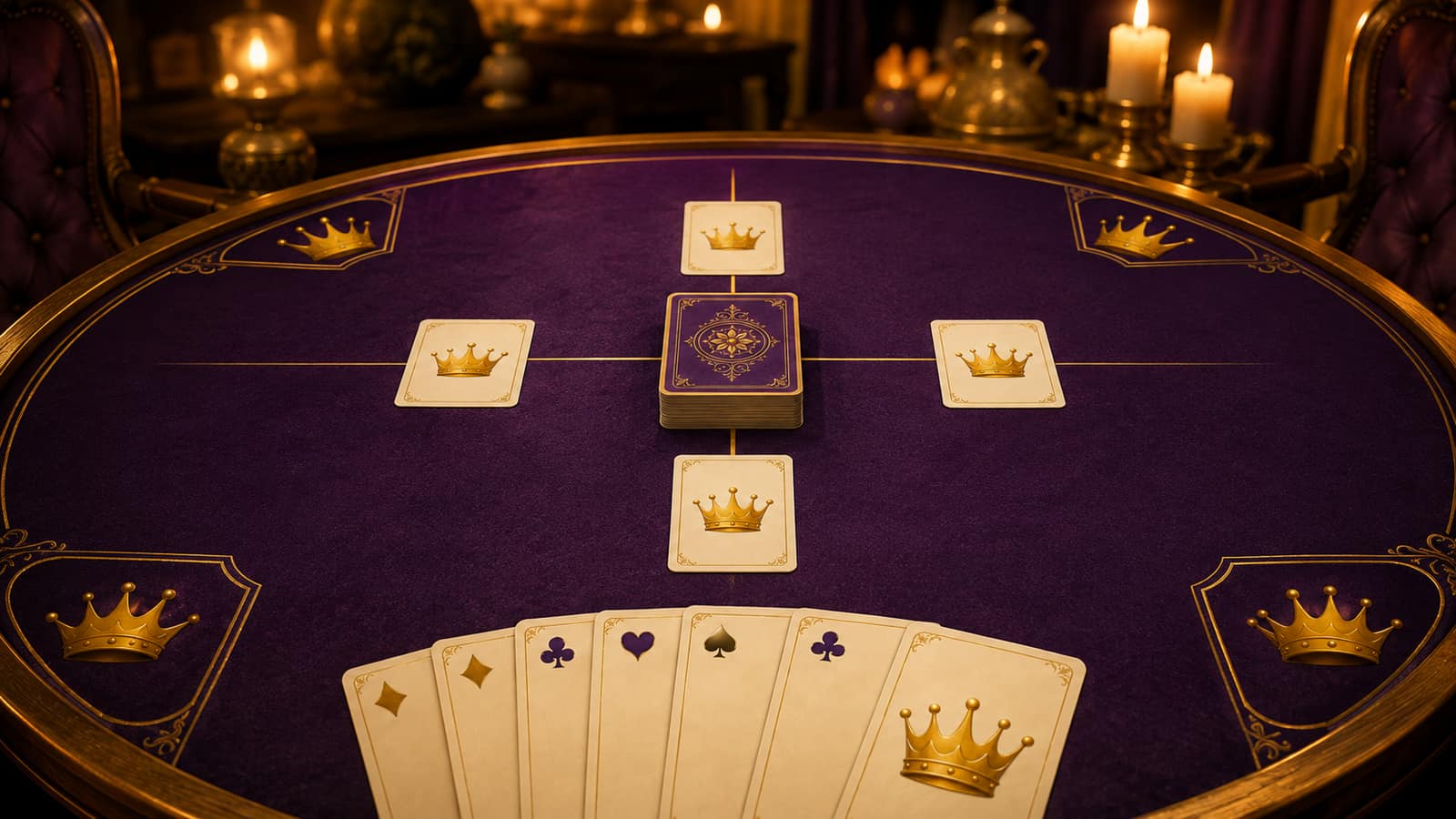
Setup and the deal
You need a standard 52-card deck with the jokers removed, and 2 to 4 players. The deal takes under a minute.
Deal 7 cards to each player
Choose a dealer (draw for it; lowest card deals). Deal seven cards to each player, one at a time, face down. Players pick up and look at their own cards.
Build the stock
Place the rest of the deck face down in the middle of the table. This is the stock (draw pile).
Flip four cards into a cross
Turn the top four cards of the stock face up and place them north, west, east and south of the stock, like the points of a compass. These start the four foundation piles.
A flipped king goes straight to a corner
If one of the four turned-up cards is a king, place it in a corner space immediately and flip a replacement card for the cross. (This is the boxed-edition rule; some casual tables leave the king in the cross instead, so decide before you start.)
The player left of the dealer goes first
Play proceeds clockwise. Each round, the deal passes one seat to the left, so nobody keeps the first-turn advantage.
Your turn, step by step
A turn is: draw one card from the stock, then make as many legal plays as you want, or none, and end your turn. You are never forced to play a card you would rather keep.
Draw one card
Take the top card of the stock into your hand. Once the stock is empty, skip this step and keep playing from what you hold.
Play cards onto the piles
Play any card from your hand that is exactly one rank lower and the opposite colour of a pile’s exposed card: a red 9 on a black 10, a black queen on a red king. Aces are the lowest card, so nothing can ever be played on an ace.
Play kings into empty corners
Only a king may start a corner pile. Once a king is in a corner, it takes normal descending, alternating-colour plays like any other pile.
Move whole piles to open a space
If the bottom card of one cross pile fits the exposed card of another pile, you may move the entire pile across in one go. The space this opens takes ANY card or pile. Spaces are the most valuable squares on the board.
End your turn
When you cannot play or choose to stop, play passes clockwise. There is no limit to how many cards you may play in one turn.
What plays where
Every legal play in the game reduces to four cases: an occupied pile, an empty corner, an empty cross space, and a whole-pile move.
| Target | What may be played there |
|---|---|
| Any occupied pile | One card exactly one rank lower and the opposite colour of its exposed card |
| Empty corner space | A king only, either from your hand or a whole cross pile whose bottom card is a king |
| Empty cross space | Any card from your hand (a space appears when a whole pile is moved away) |
| Another pile (whole-pile move) | An entire cross pile, if its bottom card fits the target’s exposed card |
- Card ranking is K-Q-J-10-9-8-7-6-5-4-3-2-A. Aces are LOW, so nothing plays on an ace, and an ace has nowhere to go except onto a red or black 2, or into a space.
- Sequences alternate red and black all the way down, exactly like a solitaire tableau.
- Corner piles never move, because a king is the highest card, so a corner pile can never legally sit on anything else.
Winning a round, and scoring the losers
The round ends the instant a player plays their last card. Everyone else counts the cards left in their hand: 10 penalty points per king, 1 point per other card. The match ends when someone reaches 25 points, and the LOWEST total wins.
- Going out mid-turn counts. You do not need to end your turn to win.
- For a single casual game, first player out simply wins (this is the version in Bicycle’s official rules).
- For match play, keep a running penalty score across rounds; 25 points is the standard end, 50 for a longer evening. Full details on the scoring page.
- If the stock is empty and a complete cycle of turns passes with nobody playing anything, the round is blocked: every player scores the hand they hold.
Glossary of terms
Corner
- One of the four diagonal spaces of the layout, reserved for kings. Only a king may start a corner pile, which is what gives the game its name.
Cross
- The four foundation piles north, west, east and south of the stock, each started with one face-up card at the deal.
Foundation pile
- Any of the piles cards are played onto, built downward in alternating colours: a red 9 on a black 10, a black 8 on the red 9.
Stock
- The face-down draw pile in the centre of the layout. Each player draws its top card at the start of their turn until it runs out.
Space
- An empty cross position created by moving an entire pile onto another pile. A space may be filled with any card or pile, which makes it the most valuable square on the board.
Going out
- Playing the last card from your hand, which ends the round immediately and scores every other player’s remaining cards against them.
Blocked round
- A round in which the stock is empty and a full cycle of turns passes with no one able or willing to play; every player scores the hand they still hold.
Frequently asked questions
How many cards do you deal in Kings in the Corner?
- Seven cards to each player, regardless of whether two, three or four are playing. The rest of the deck becomes the central draw pile, with four cards turned face-up around it.
Is Kings Corner 5 or 7 cards?
- Seven. The standard deal is seven cards each, and that is the count used by the published rules and by the game on this page. Five turns up as a house rule for shorter rounds or for playing with young children, and it works fine, but it is a variation rather than the standard game.
Do you draw a card at the beginning or end of your turn?
- At the beginning. The official sequence is: draw one card from the stock, then make as many plays as you wish, then pass. Some house rules draw at the end of the turn instead, so agree before you start, because it changes when a drawn card can first be played.
Do you have to draw every time in Kings Corner?
- Yes, while the stock still has cards. The draw is the fixed opening of every turn rather than an option, so you cannot skip it to keep your hand small. Since the winner is whoever empties their hand first, that forced card slows down a player who is close to going out. Once the stock is empty the draw stops and turns become plays only.
Can you put any card in the corner in Kings in the Corner?
- No. An empty corner takes only a king. Once a king is there, the corner pile builds down in alternating colours like any other pile: a black queen on a red king, and so on.
What happens when the draw pile runs out?
- Play continues without drawing, so each turn is simply plays from the hand. If a full cycle of turns passes and nobody plays anything, the round is blocked and every player scores the cards they still hold.
Are aces high or low in Kings in the Corner?
- Aces are low, and the sequence runs king down to ace. An ace can only be played onto a 2 of the opposite colour or into an empty space, and nothing can ever be played on top of an ace.
How many points is a king worth in Kings in the Corner?
- A king left in your hand when someone goes out costs you 10 penalty points; every other card costs 1. That 10-to-1 ratio is why getting kings into corners early is the single most important habit in the game.
Can you move a whole pile in Kings in the Corner?
- Yes. If the bottom card of one cross pile fits the exposed card of another pile (one rank lower, opposite colour), you may move the entire pile across in one go. The space it leaves behind can then be filled with any card.
Is Kings in the Corner the same as Kings Corner?
- Yes. Kings Corner, Kings Corners and King’s Corner are all names for the same game. The boxed edition sold since 1996 uses "Kings in the Corner"; casual players shorten it.
What else is Kings in the Corner called?
- Kings Corner, Kings Corners, King’s Corner, Kings on the Corner, Kings Around the Corner and Four Kings in a Corner all describe the same game. Only the name varies; the rules are the same in every version.
How many cards do you get in Kings Corner?
- Seven each, whatever the number of players. The rest of the deck becomes the draw pile, and four cards are turned from it to start the four foundation piles.
Sources
The rules above follow the two published sources that agree on every core point: Bicycle’s official Kings Corner rules (bicyclecards.com/how-to-play/kings-corner) for the deal, turn order and legal moves, and the boxed-edition rules for the 10-points-per-king penalty scoring and the flipped-king replacement at setup. Where casual tables differ, as with draw timing and scoring targets, the variants page names each difference rather than pretending there is one true version.